Short-Term Rentals in Puglia 2026: Regulations, Requirements and What Property Owners Need to Know
Renting out a property in Puglia for short stays now involves a number of administrative requirements and checks to ensure that the property complies with current regulations.
The rules apply to short-term rentals and tourist rentals, but it is important to distinguish these from Case e Appartamenti per Vacanze, commonly known as CAV, which are classified as tourist accommodation facilities and are subject to different regulations.
Before putting a property on the market, it is therefore essential to establish which type of activity applies and make sure that the property meets all the relevant requirements.
 What is a short-term rental or tourist rental?
A tourist rental involves renting out a property, or part of a property, exclusively for tourism purposes.
For short-term rentals of less than 30 days, certain services directly connected with the use of the property are also permitted, such as linen supply and cleaning, as well as utilities, Wi-Fi and air conditioning.
It is important to distinguish tourist rentals from accommodation businesses, as the applicable requirements and obligations may differ.
CIA or SCIA: which one is required for short-term rentals in Puglia?
The administrative procedure depends on how the rental activity is carried out.
For tourist rentals operated on a non-business basis, a CIA, Comunicazione di Inizio Attività, or Start of Activity Notification, is required.
For tourist rentals operated as a business, a SCIA, Segnalazione Certificata di Inizio Attività, or Certified Notification of Business Activity, must be submitted to the SUAP, the local authority's one-stop business desk, in the municipality where the property is located.
The Puglia Region has also introduced transitional provisions for activities already registered with the DMS Puglia system.
For activities covered by these transitional provisions, the deadline for submitting the CIA or SCIA has been extended to 31 December 2026.
When is a rental activity considered a business?
Since 2026, the number of properties being rented out is also an important factor.
Under national legislation referred to by the Puglia Region, tourist rental activity is presumed to be carried out on a business basis when more than two apartments are made available for rent during the same tax year.
Owners who have or manage several properties for short-term rentals should therefore check their tax and administrative status carefully with their accountant or other qualified professional.
CIR and CIN: what does a property need for short-term rentals?
Properties used for short-term or tourist rentals must be registered with DMS Puglia, the regional Digital Management System.
Once registered, the property is assigned a CIR, Codice Identificativo Regionale, or Regional Identification Code.
The CIR allows the property to be registered with the national database of tourist accommodation facilities and properties used for short-term and tourist rentals, and to obtain the CIN, Codice Identificativo Nazionale, or National Identification Code.
The CIN must be obtained according to the applicable procedure and must be included in online listings.
It must also be displayed outside the building where the property is located, in compliance with any applicable planning or landscape restrictions.
Safety requirements: gas, carbon monoxide detectors and fire extinguishers
Specific safety requirements apply to properties used for short-term and tourist rentals.
Working detectors for combustible gases and carbon monoxide must be installed where required by law.
Portable fire extinguishers that comply with current regulations are also mandatory.
The Puglia Region requires at least one fire extinguisher for every 200 square metres of floor area, or part thereof, with a minimum of one extinguisher per floor.
Fire extinguishers must be placed in an accessible and clearly visible position.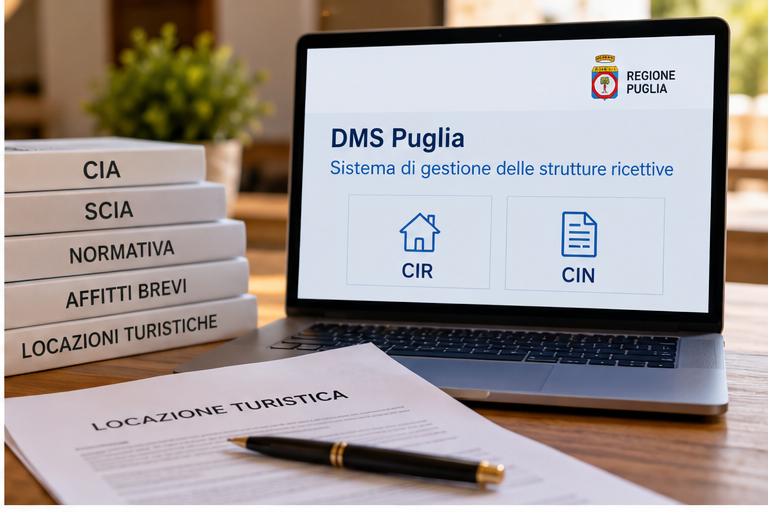
Mandatory liability insurance
Tourist rentals are also subject to an insurance requirement covering civil liability towards guests.
This requirement applies both to business and non-business tourist rentals.
The insurance coverage must be appropriate to the property's authorised guest capacity.
The property itself must be compliant
Having a CIN does not automatically mean that a property complies with every applicable requirement.
Before starting or continuing a short-term rental activity, it is essential to check the property's planning, building and cadastral status and ensure that its intended use is compatible with the activity being carried out.
It is therefore advisable to appoint a qualified professional to carry out a comprehensive assessment of the property.
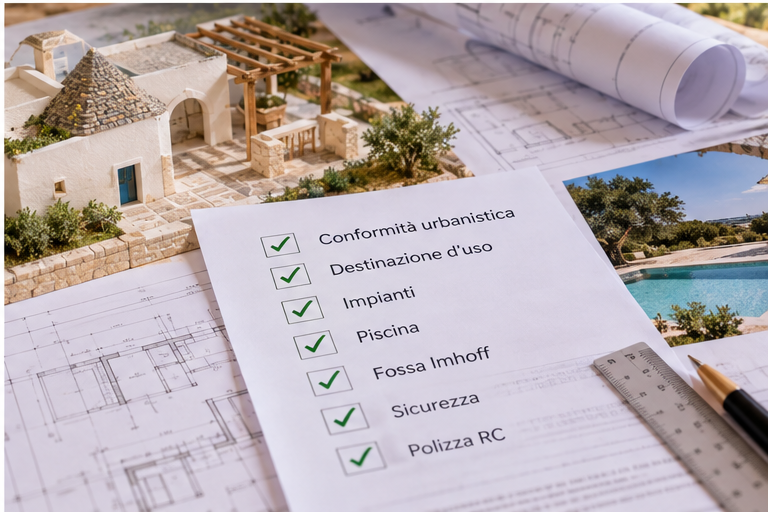
Depending on the individual property, the professional should verify:
• planning and building compliance
• cadastral compliance
• permitted use of the property
• building permits and other relevant authorisations
• occupancy or habitability certification, where applicable
• consistency between the actual condition of the property and its official documentation
• authorised guest capacity
• compliance of electrical, gas, water and other systems
• any landscape or environmental restrictions
• the legal status of any trulli, lamie, annexes, verandas or other buildings on the property.
Ceiling heights, floor areas and number of guests
There is no single ceiling height or floor area requirement that applies automatically to every residential property used for short-term rentals.
Requirements must be assessed according to the type of property, the applicable building regulations, its permitted use and any relevant local regulations.
It is also important not to confuse the standards applicable to Case e Appartamenti per Vacanze, or CAV, with those applicable to ordinary tourist rentals.
For CAV properties, for example, regional legislation sets specific minimum bedroom sizes.
These requirements should not automatically be applied to properties operated as tourist rentals.
Swimming pools: what property owners need to check
A swimming pool requires a specific compliance assessment.
Not all pools located at properties used for short-term rentals are subject to exactly the same requirements.
The applicable rules may depend on the type of pool, its intended use and how it is operated in connection with the tourist activity.
Property owners should therefore ask a qualified professional to verify:
• the planning and building compliance of the pool
• any permits or authorisations that may be required
• the pool's technical systems and related documentation
• health and hygiene requirements
• applicable safety requirements
• any additional obligations arising from the specific type of pool.
Septic tanks and wastewater disposal
For many villas, masserie and trulli located in rural areas, wastewater management is particularly important.
Where a property is not connected to the public sewerage system, the system used to treat and dispose of wastewater must be checked for compliance.
The mere presence of a septic tank or Imhoff tank does not automatically mean that the system is compliant.
A qualified professional should verify the existing treatment system, any required permits or authorisations, the final discharge arrangements and compliance with the environmental regulations applicable to the property.
Short-term rentals and Case e Appartamenti per Vacanze: an important distinction
A Casa o Appartamento per Vacanze, commonly referred to as a CAV, is a tourist accommodation facility regulated by regional legislation.
A tourist rental, on the other hand, is subject to a different legal framework.
CAV properties are subject to specific structural and organisational requirements established by regional law.
It is therefore essential to correctly identify the type of activity before marketing a property.
Other requirements
Managing a property as a short-term rental also involves a number of additional obligations.
These include:
• reporting guests through Alloggiati Web
• submitting tourist data through the regional reporting systems
• complying with any municipal tourist tax requirements, where applicable
• keeping the property's registration details up to date in the relevant regional and national systems.
Why working with a qualified professional is essential
The compliance of a property used for short-term rentals cannot be assessed simply by checking whether it has a CIN.
Planning and building regulations, cadastral records, utilities and installations, safety requirements, landscape restrictions, swimming pools and wastewater systems may all require separate checks.
For this reason, particularly for villas, trulli, masserie and rural properties, it is important to appoint a qualified professional before putting the property on the market.
The professional can assess the specific circumstances of the property and identify any works or documentation required to bring it into compliance.
What to check before starting a short-term rental in Puglia
Before listing a property for short-term rental, it is advisable to check:
• the correct legal classification of the rental activity
• registration with DMS Puglia
• CIR
• CIN
• CIA or SCIA, where required
• planning and building compliance
• permitted use of the property
• cadastral compliance
• compliance of utilities and installations
• safety equipment
• fire extinguishers
• liability insurance
• any planning, landscape or environmental restrictions
• swimming pool compliance, where applicable
• wastewater disposal compliance, where applicable
• authorised guest capacity
• guest reporting and tourist data requirements.
Short-term rentals in Puglia: keep up with regulatory changes
The regulations governing short-term and tourist rentals are constantly evolving.
For this reason, it is important to regularly check updates issued by the Puglia Region, the Italian Ministry of Tourism and the municipality where the property is located.
The Puglia Region has recently extended the deadline to 31 December 2026 for submitting the CIA or SCIA under the transitional rules applicable to certain existing short-term and tourist rental activities.
Before starting or continuing a rental activity, it is therefore always advisable to have the specific situation of the property reviewed by a qualified professional.
For property owners, the principle is simple: before renting out a property for short stays, make sure that the activity is correctly classified and that the property complies with all applicable requirements.
HelloApulia manages and markets properties on behalf of their owners. Responsibility for the property's technical, planning, building and systems compliance remains with the owner, who should rely on appropriately qualified professionals for the necessary checks.